Shares of HLB and Lunit also posted steep losses as separate negative catalysts surfaced.

ABL Bio Inc. share price movement on Jan. 30 (Source: KG Zeroin MP Doctor)
◇Sanofi Reprioritizes ABL301, Raising Pressure to Reassess Its Value
According to KG Zeroin’s MP Doctor (formerly MarketPoint), ABL Bio closed at won 197,700, down won 47,800 (-19.47%) from the previous session. Earlier in pre-market trading, the stock had already fallen won 29,000 (-11.81%) to won 216,500, reflecting early shock.
Selling pressure intensified despite company explanations after news spread that Sanofi had reprioritized development of ABL301, ultimately pushing the stock below the psychologically important won 200,000 level.
In its fourth-quarter earnings release on Jan. 29 (local time), Sanofi said SAR446159 (ABL301) had been designated as “deprioritised.” While the asset has not been removed from Sanofi’s R&D pipeline the move is widely interpreted as a signal that it is no longer considered a near term core asset internally.
Some investors raised concerns that the reprioritization could lead to a clinical halt or rights reversion. However industry watchers cautioned that it is premature to draw such conclusions.
Seung min Kim an analyst at Mirae Asset Securities noted that Sanofi typically uses “negative” when data issues arise and “terminated” when trials are stopped. “‘Deprioritised’ simply indicates a lower priority.” he said.
Concerns also grew after reports suggested Sanofi may pursue an additional Phase 1b study rather than moving directly into Phase 2 potentially delaying the overall development timeline.
As ABL Bio is entitled to milestone payments upon Phase 2 entry, such a delay could significantly weaken near term earnings visibility.
As a result pressure is mounting to reassess the pipeline value of ABL301. The bispecific antibody candidate for neurodegenerative diseases was licensed to Sanofi in January 2021 in a deal worth up to $1.06 billion (about won 1.47 trillion).
The asset holds symbolic importance as the first global co development program applying ABL Bio’s blood brain barrier shuttle platform, Grabody-B, to a real-world indication Parkinson’s disease.
Brokerage reports published this month estimate the average drug value of ABL301 at won 1.89 trillion. Daol Investment & Securities and Yuanta Securities estimate the asset accounts for 11% and 27.6%, respectively, of ABL Bio’s total pipeline value.
Notably Daol recently raised its valuation of the Grabody-B platform from won 4.97 trillion to won 10.47 trillion after reassessing the Alzheimer’s disease indication.
ABL Bio stressed that development of ABL301 has neither been halted nor subject to rights reversion.
“The clinical program has not been discontinued, nor has the contract been terminated or rescinded.” a company official said adding that Sanofi’s commitment remains strong and communications are ongoing.
Addressing concerns over delays, the official said upcoming studies will adopt more direct and precise analytical methods to assess efficacy calling the approach “a strategic choice to improve the probability of clinical success not a simple schedule slip.”
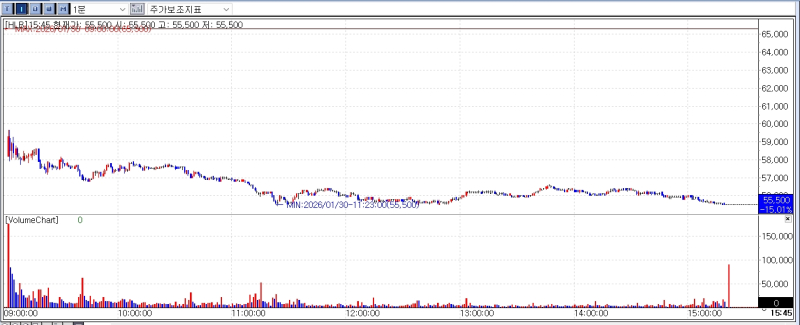
HLB Co., LTD. share price movement on Jan. 30 (Source: KG Zeroin MP Doctor)
◇HLB’s Rivoceranib Gets Class 2 Review, Approval Delayed
HLB traded lower throughout the session and closed at won 55,500, down won 9,800 (-15.01%). Investor sentiment cooled after the U.S. Food and Drug Administration (FDA) classified the resubmitted review of rivoceranib as Class 2, extending the review period by up to six months.
At 9:05 a.m., HLB said it had resubmitted a New Drug Application (NDA) for rivoceranib in combination with camrelizumab to the FDA on Jan. 23 (local time). Two business days later the agency accepted the filing for substantive review and notified the company of the Class 2 designation.
HLB explained that the classification stemmed from a single remaining issue identified during a prior CMC inspection and that, under FDA rules, any manufacturing related item regardless of severity triggers a Class 2 review.
Under FDA guidelines, Class 1 reviews typically conclude within two months, while Class 2 reviews allow up to six months. As a result a final decision on rivoceranib is now expected by July 23.
Markets expressed disappointment that the filing did not receive a Class 1 designation with the longer waiting period cited as a key factor weighing on investor sentiment.
An HLB official said partner Hengrui Pharmaceuticals has worked closely with the FDA over the past 10 months to address all comments.
“Given how thoroughly prepared we are, we remain hopeful and will see the process through calmly.” the official said.
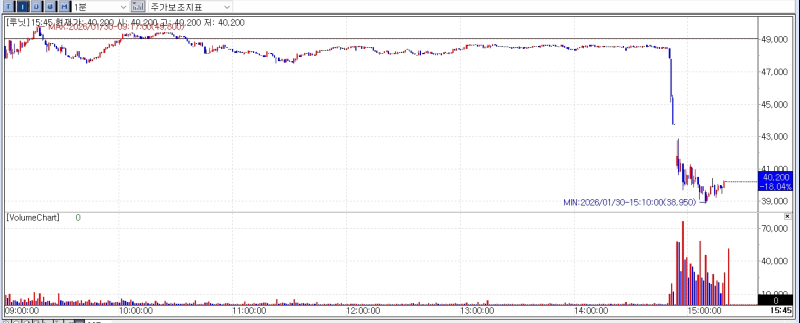
Lunit Inc. share price movement on Jan. 30 (Source: KG Zeroin MP Doctor)
◇Lunit Falls on Fundraising Speculation, Confirms Rights Offering
Lunit Inc. reversed sharply lower after 2:49 p.m. on reports that the company was considering a roughly won 200 billion capital raise, closing down won 8,850 (-18.04%) at won 40,200. While large-scale fundraising had been widely anticipated investor sentiment deteriorated rapidly as a rights offering emerged as the most likely structure.
After the market closed at 4:38 p.m., Lunit disclosed plans for a won 250 billion rights offering accompanied by a 1 for 1 bonus issue. The deal will be structured as a rights offering with a public subscription for unsubscribed shares issuing 7,906,816 new shares equivalent to 27% of the current outstanding shares (29,284,502).
Of the proceeds, won 137.8 billion will be used for debt repayment and won 112.5 billion for operating funds including R&D and overseas expansion. The company said it had initially explored a third party allocation of convertible preferred shares (CPS) but concluded that approach would not sufficiently address the put-option risk embedded in outstanding convertible bonds prompting the shift to a rights offering.
The move marks Lunit’s first rights offering in three years, following a won 200.2 billion offering in 2023. The company raised won 171.5 billion through two private convertible bond issuances in 2024, and won 35.8 billion from its 2022 KOSDAQ IPO.
Including the current deal, cumulative capital raised over the past four years would reach won 659 billion, up from won 409 billion previously.
Meanwhile brain disease AI specialist NEUROPHET surged to the daily upper limit, closing up won 6,500 (+29.89%) at won 28,250. The rally followed a disclosure that Samsung Active Asset Management had acquired 582,764 shares equivalent to a 5.01% stake for passive investment purposes.
The asset manager disclosed the purchase after the previous session’s close, noting that the shares were acquired on Jan. 22. A Neurofit official said the announcement likely had a positive impact on buying interest driving the stock to its upper limit.