Komipharm drew investor attention after the country reported its sixth outbreak of African swine fever, or ASF, this year at a domestic pig farm. The company is developing an ASF vaccine. HLB Innovation also climbed after regulatory filings showed that HLB Group Chairman Jin Yang-gon and his children had acquired additional stakes, reinforcing its status as a potential next core affiliate within the group.
Biodyne gained momentum after a PharmEdaily article published before the market open revisited its earlier contract with a global pharmaceutical company, putting the stock back in the spotlight.
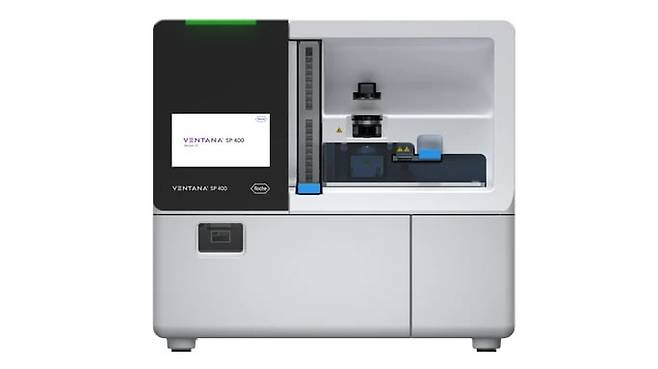
Early diagnostic equipment for cervical cancer 'Ventana SP400' (Source: Roche)
◇Biodyne revalued on high royalties ahead of earnings inflection
Shares of Biodyne, which develops early diagnostic equipment for cervical cancer, closed at 14,800 won, up 8.2 percent from the previous session. The rally followed a PharmEdaily report published at 8:22 a.m. local time that highlighted Biodyne’s licensing deal with Roche.
According to the report, Biodyne licensed its liquid-based cytology technology known as Blowing to Roche in 2019 for use in early cervical cancer diagnosis. Under the agreement, Roche is expected to pay Biodyne royalties in the low double-digit percentage range on sales of the Ventana SP400 diagnostic platform and related reagents incorporating the technology.
Rather than linking royalties to a percentage of sales, the agreement stipulates fixed payments per unit sold. The fixed amount is equivalent to a low double-digit percentage of the average selling price of Biodyne’s products and those of its competitors, according to the report.
In the pharmaceutical and biotech industry, royalty rates typically fall in the single-digit range as a percentage of sales. As a result, Biodyne securing double-digit-level royalties in its first deal with a major pharmaceutical company is widely seen as an encouraging achievement.
A Biodyne official said Ventana SP400 is scheduled for additional launches this year in more than 40 countries across Europe, North America, Central and South America, and Asia. Royalties from the Japan launch are expected to be received in the first quarter, with additional payments to follow as the product rolls out in other markets.
◇ASF vaccine draws interest from Philippine government
Komipharm, an animal health company, closed up 15.4 percent at 8,450 won. The stock surged after news that pigs at a farm in Boryeong, South Chungcheong Province tested positive for ASF.
ASF is a highly contagious livestock disease with a fatality rate of up to 90 percent. While it does not infect humans, it causes massive economic damage to the pork industry, as infected farms are required to cull all pigs under standard operating procedures. An effective vaccine could prevent mass culling during ASF outbreaks.
Although ASF vaccines have been developed in countries such as Vietnam, their reliability remains limited, driving strong global demand for more effective options. Industry estimates put China’s ASF vaccine market alone at about 2.5 trillion won annually.
Komipharm is considered one of the leading ASF vaccine developers and is working on a next-generation vaccine designed to overcome the shortcomings of existing products. The company is currently conducting clinical trials in the Philippines and Vietnam targeting commercialization within the year.
Chief Executive Moon Sung-jun said the Philippine government has shown particular interest. He said the government sent an official request on Jan. 26 asking Komipharm to submit all accumulated data on its ASF vaccine by Feb. 6.
Government officials have since completed an on site inspection raising the possibility of an approval process significantly faster than standard vaccine procedures.
Moon said earlier tests showed 100 percent survival in pigs subjected to challenge tests four eight and 12 weeks after vaccination. Vaccination is typically administered at eight to 10 weeks of age and given the pigs’ life cycle additional doses are unlikely to be necessary.
◇Is HLB Innovation emerging as the group’s new core?
HLB Innovation rose 8 percent to 3,095 won after disclosures showed that Chairman Jin’s two children had acquired shares in the company. Among the 10 listed affiliates of the HLB Group, HLB Innovation was the only one to finish higher on the day.
Jin has two daughters. The elder, Jin Yu-rim, serves as a director at HLB and is involved in the group’s food and beverage business while the younger Jin In hye, has worked as an executive at Verismo Therapeutics, HLB Innovation’s U.S. subsidiary and is engaged in the group’s biotech operations.
An HLB official said a filing on Feb. 3 disclosed that Jin himself had purchased 160,000 shares of HLB Innovation on the open market on Jan. 30 and Feb. 2. The consecutive share purchases by the group’s top decision maker and related parties have underscored HLB Innovation’s growing strategic importance within the group.
HLB is currently seeking U.S. Food and Drug Administration approval for a combination therapy of rivoceranib and camrelizumab for liver cancer. Within the group, attention appears to be shifting to Verismo’s solid tumor chimeric antigen receptor T-cell, or CAR-T, therapy as a post rivoceranib growth driver.
Until two years ago, HLB Therapeutics, which holds assets such as the neurotrophic keratitis treatment RGN-259, was viewed as the leading candidate to deliver the group’s next blockbuster. Jin also drew market attention at the time by repeatedly purchasing shares of HLB Therapeutics.
That outlook dimmed after RGN-259 failed its fifth Phase 3 trial in Europe, known as SEER-3. Since then, HLB Innovation which holds a solid tumor CAR-T candidate gaining global attention, has emerged as the group’s new focus. RGN-259 is currently undergoing a U.S. Phase 3 trial, SEER-2, with topline results expected in June.