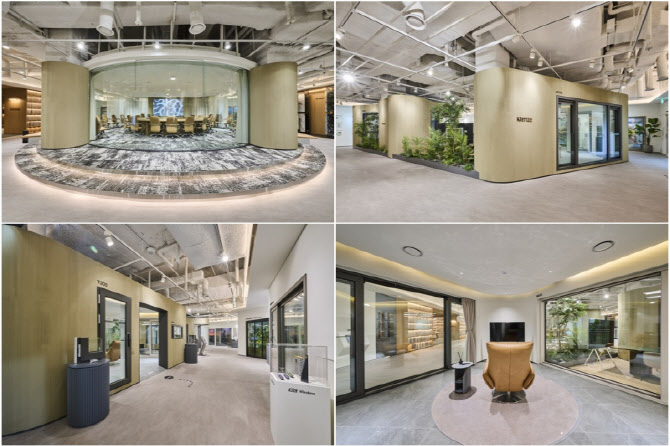
On this day, the market saw a concentrated influx of buying interest toward "Bio So Bu Jang" (Materials, Parts, and Equipment) companies with specialized technological moats and firms undergoing management transitions.
The key protagonists of the market were XcellTherapeutics, Celemics and QuadMedicine. In particular Xcell Therapeutics which possesses proprietary technology for Cell and Gene Therapy (CGT) media hit the upper price limit leading the sector's momentum.
It was followed by Celemics fueled by news of a change in its largest shareholder and QuadMedicine which proved its innovative platform capabilities through a major government project.
The explosive rally of Xcell Therapeutics was analyzed as being triggered by the surge in demand for "Chemically Defined Media" (CDM) following regulatory changes in Taiwan.

Xcell Therapeutics Stock Price Trend
◇Xcell Therapeutics: Strategic Shift to Exclusive Contract in Taiwan Drives Market Frenzy
According to KG Zeroin MP Doctor, Xcell Therapeutics closed at 1,912 won up 29.9% from the previous trading day on the KOSDAQ market. The news of its Taiwanese partner transitioning to an exclusive distribution agreement acted as a major catalyst for investor sentiment.
This momentum followed an exclusive report by PharmEDaily on Feb 4, featuring an interview with Yi Ui-il, CEO of Xcell Therapeutics, who predicted double digit growth in Taiwan as the market shifts toward chemically defined media.
Xcell Therapeutics is a specialized bio-equipment firm that develops and produces serum free chemically defined media essential for manufacturing CGTs. The company's proprietary CDM is recognized as a next-generation solution that eliminates the risk of viral infection and quality variance associated with traditional Fetal Bovine Serum (FBS) media.
Since 2024, the company has targeted the Taiwanese market through a partnership with "I" a prominent local bio distributor. In just two years Taiwan emerged as a core market accounting for the largest share of the company’s overseas revenue.
Partner "I" recently converted its non exclusive contract into an exclusive one and visited Xcell Therapeutics’ headquarters and GMP facilities on Jan 20 to finalize this year’s business plans.
"Taiwan is our core region and is showing the fastest results among our global entry points" said CEO Yi Ui il. "As the local CGT market enters the commercialization stage an environment requiring safe CDM is being established. We expect double-digit revenue growth in Taiwan alone."
The company already received initial orders for its flagship Mesenchymal Stem Cell (MSC) media, CellCor™ MSC CD AOF. Major Taiwanese cell banking firms and multiple CGT developers confirmed the adoption of Xcell’s MSC media.
Furthermore the Taiwan Ministry of Health and Welfare (MOHW) implemented a regulation last May requiring evidence of pathogen risk and virus inactivation for all reagents used in cell therapy manufacturing serving as a significant tailwind for the company.
Industry experts noted "The technical moat of Xcell Therapeutics is becoming more prominent alongside the localization trend of bio materials. The success in Taiwan proves that the company meets global standards, raising expectations for a valuation re-rating upon its entry into the U.S. market."
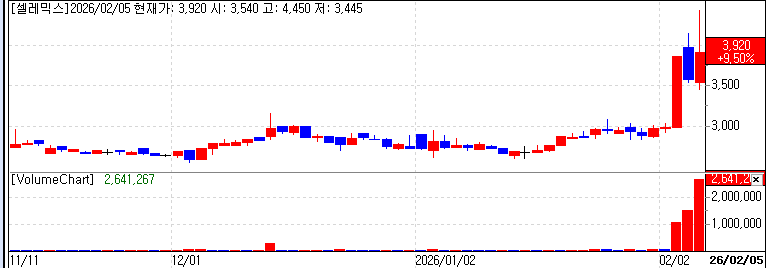
Celemics Stock Trend
◇Celemics: Up 9.5% Following Largest Shareholder Change Announcement
Celemics a genomic analysis technology company, closed at 3,920 won, up 9.5% on Feb 5 continuing its upward trend from the previous day’s limit up. The surge reflected market expectations for business diversification following the disclosure of a change in its largest shareholder and a 4.3 billion won third party allocation capital increase.
Celemics specializes in "Target Capture Kits" which allow for the efficient screening of specific genomic regions. Its proprietary MSSIC (Massive Separated and Sequence Identified Cloning) technology is a core reagent used in Next-Generation Sequencing (NGS) and can detect COVID-19 variants even from trace samples.
Under the stock transfer agreement, co CEOs Lee Yong hoon and Kim Hyo gi will transfer approximately 430,000 shares (5.27% of total issued shares) to Park Jong gap at 6,000 won per share. Park will become the largest shareholder with a 5.97% stake, and management control is expected to be transferred during the extraordinary general meeting scheduled for March 5.
The 4.3 billion won raised through the capital increase will be used for operations and business diversification. Additionally, the company plans to issue 5 billion won in Convertible Bonds (CB), allocating 1 billion won to recruitment and market expansion and 400 million won to intangible asset acquisition and overseas branch operations.
While Celemics recorded a revenue of 6.7 billion won and an operating loss of 1.9 billion won in 2024, it has benefited from valuation gains from its 9.8% stake in IMBDx, a liquid biopsy specialist. The market is now watching whether the new leadership and funding will serve as a turning point for the company.
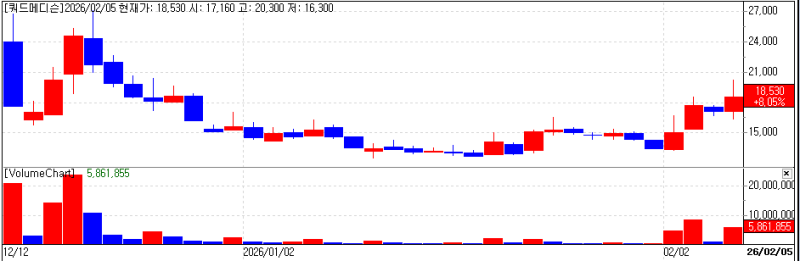
QuadMedicine Trend
◇QuadMedicine: Rises 8% on Selection for Phase 2 of K-ARPA-H Project
Medical microneedle platform specialist QuadMedicine closed at 13,530 won, up 8%. The rally was driven by the news that the company was selected for Phase 2 of the "Korean ARPA-H Project" in the health security sector, managed by the K-Health Future Promotion Agency.
QuadMedicine holds proprietary technology for microneedles that can deliver vaccines or drugs simply by being applied to the skin. The K-ARPA-H project, modeled after the U.S. government’s ambitious R&D program, was launched in 2024 to solve national challenges.
The QuadMedicine consortium has been conducting research since being selected for the STOREx (Ultra long term Vaccine Storage Technology Development) project last year.
In Phase 1, the company applied its Microarray Patch (MAP) material technology to mRNA-LNP (Lipid Nanoparticle) formulations, confirming stability for over six months at refrigerated conditions (2~8°C). This is a breakthrough considering traditional mRNA-LNP vaccines require an ultra-cold chain of -20°C to -70°C, which limits distribution in infrastructure-poor regions.
Crucially, Q10-based stability prediction modeling showed that the technology could maintain over 90% drug activity for up to three years. Out of multiple consortia in Phase 1, only two were selected for Phase 2, with QuadMedicine securing one of the spots.
In Phase 2, QuadMedicine aims to secure long-term storage data of up to five years for its MAP-applied mRNA-LNP prototypes. The company has already established GMP-certified facilities and an automated manufacturing system.
Last year it gained international attention as a next-generation vaccine delivery platform after being invited to the WHO Measles Rubella Microneedle meeting.
"This selection proves that microneedle technology is a core material technology that can drastically improve storage stability, a prerequisite for next generation vaccines." said a QuadMedicine official. "We will contribute to national vaccine sovereignty and strengthen our technological competitiveness in the global vaccine market."