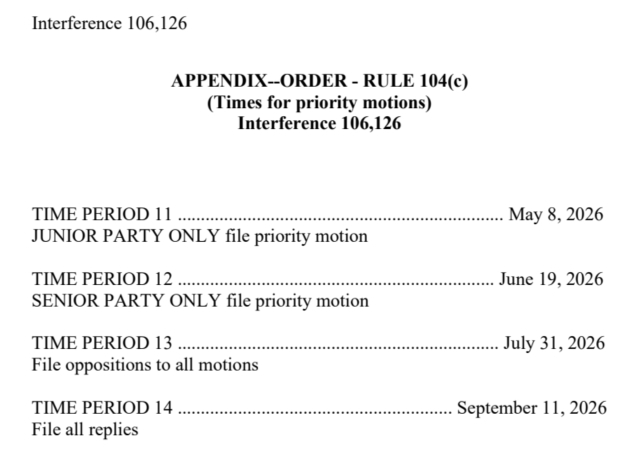
Schedule for patent interference proceedings between Toolgen and the Broad Institute (Source = U.S. Patent Trial and Appeal Board)
◇Toolgen rises 10% as key schedule set
Toolgen closed up 10.78% at 59,600 won from the previous session. The gain appeared driven by expectations that the CRISPR gene editing patent dispute has entered a decisive phase. The U.S. Patent Trial and Appeal Board resumed interference proceedings and began the priority determination process.
On March 31 local time, the board restarted the interference case between the Broad Institute and Toolgen and set a schedule to determine priority.
The move effectively reactivates proceedings that had been paused following a remand, marking entry into a critical stage to determine who first invented the technology. Under the schedule, the Broad Institute must submit its priority claims by May 8, while Toolgen is required to respond by June 19. Rebuttals and counter rebuttals will follow, with hearings expected to continue through the end of the year.
The market views the schedule not as a routine administrative step but as the starting point for determining patent ownership. The dispute, long delayed, is now seen as moving toward a conclusion.
If Toolgen secures priority, it could gain control over the relevant patent family and generate royalty income, directly boosting monetization expectations.
From an investment perspective, reduced time uncertainty is a key factor. With a defined timeline, visibility on when an outcome may emerge has improved.
◇Curiox declines despite Big Pharma framework deal
Curiox Biosystems closed down 13.91% at 87,300 won. The drop came despite signing a framework agreement last month with a top 10 global pharmaceutical company, as specific order volumes have yet to be confirmed, prompting profit-taking.
The company said it will take time for the agreement to translate into actual revenue.
“Based on the framework agreement, we now need to expand sales to individual labs within the client organization,” a company official said. “It will take some time before concrete performance figures are realized.”
Curiox develops equipment that automates washing and separation steps, which are essential in cell analysis workflows. These processes have traditionally been performed manually using centrifugation, but automation improves efficiency and reproducibility.
Future stock momentum may hinge on reproducibility validation results. The company has completed comparative testing using its Pluto workstation and aims to present the results at a major academic conference in midyear. Demonstrating consistent results across different research environments could significantly enhance confidence in its technology.
◇Biodyne gains on dividend transition expectations
Biodyne rose 5.88% to 12,600 won. Investor sentiment improved after a PharmEdaily premium article highlighted the company’s potential to expand dividends.
At its recent annual general meeting, the company eliminated accumulated deficits using capital surplus, establishing a structure that enables dividend payments. In addition, royalty income based on its agreement with Roche is expected to provide stable cash flow.
Global expansion of the Ventana SP400 cervical cancer diagnostic system is also expected to drive revenue growth without significant additional costs. The market estimates annual royalty income could exceed 40 billion won by 2028.
The major shareholder structure is also seen as supportive of dividend expansion. Under its agreement with Roche, maintaining a certain ownership stake is required, increasing incentives to return cash through dividends rather than share sales.
Government value-up policies may also play a role. In an environment of rising pressure for shareholder returns, expanding dividends is increasingly viewed not as an option but as a strategy to support valuation.
While biotech companies have typically offered limited dividends due to heavy R&D spending, Biodyne is drawing attention as a rare case of a dividend-paying biotech backed by royalty-based cash flow.