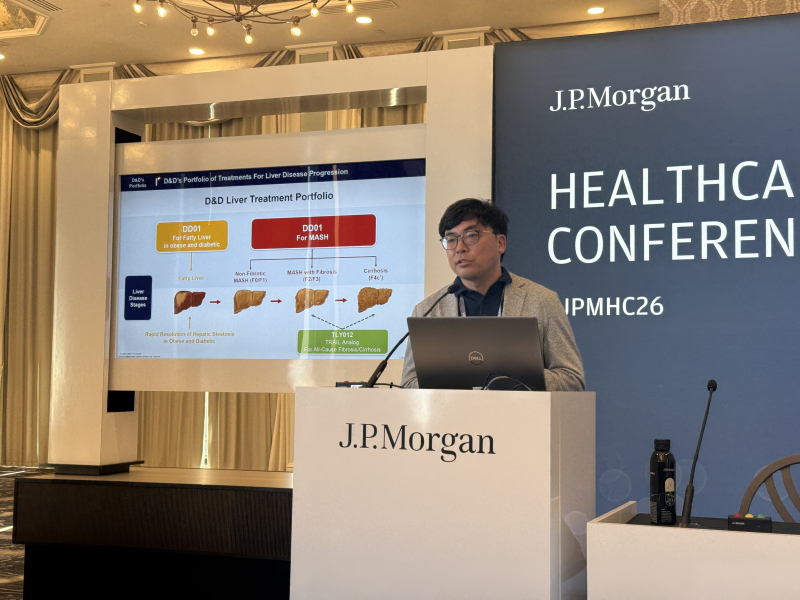
D&D Pharmatech CEO Seulki Lee introduces DD01 at the J.P. Morgan Healthcare Conference held in San Francisco in January. (Source: Edaily DB)
◇D&D Pharmatech gains on MASH big deal hopes, CEO set to present data
According to KG Zeroin’s MP DOCTOR, formerly Marketpoint, D&D Pharmatech closed at 94,000 won, up 9,900 won, or 11.77%, from the previous session.
D&D Pharmatech held an investor relations session the same day to present 48-week biopsy results from its Phase 2 MASH trial of Zabopegdutide, also known by its development code DD01. The stock’s gains appear to have been driven by rising expectations for a licensing deal after the company said the drug achieved statistical significance across three key endpoints.
D&D Pharmatech, in particular, highlighted a string of recent global MASH deals as evidence that it may be able to secure favorable licensing terms with a major pharmaceutical company.
For example, GSK agreed in May last year to acquire Boston Pharmaceuticals’ MASH candidate efimosfermin in a deal worth up to $2 billion. Roche signed a deal in September last year to acquire 89bio’s pegozafermin, then in Phase 3 development, for up to $3.5 billion. Novo Nordisk followed in October with an agreement to acquire Akero Therapeutics’ Phase 3-stage efruxifermin for up to $5.2 billion.
D&D Pharmatech’s confidence appears to stem from DD01’s favorable biopsy data versus competing candidates. According to the company’s IR materials, DD01 achieved statistical significance in three key biopsy endpoints: MASH resolution without worsening of fibrosis, fibrosis improvement without worsening of MASH, and the composite endpoint of both MASH resolution and fibrosis improvement. Based on these results, the company said DD01 has competitiveness equal to or greater than recently acquired FGF21-class candidates.
News that D&D Pharmatech CEO Seulki Lee will personally attend and present at a briefing hosted by Kiwoom Securities on June 11 in Yeongdeungpo-gu, Seoul, to discuss the Phase 2 MASH results also appears to have partly contributed to the stock’s rise.
“At today’s IR session, we mainly provided a detailed explanation of data that had already been disclosed,” a D&D Pharmatech official said. “At the June 11 briefing, CEO Lee will attend and plans to disclose various additional information.”
◇Aimed Bio drops as six-month lock-up expiry revives overhang concerns
Aimed Bio, an antibody-drug conjugate (ADC) developer, plunged on concerns over shares released from lock-up six months after its listing.
Aimed Bio, which listed in December last year, closed at 27,700 won, down 6,050 won, or 17.93%, from the previous session. The decline is interpreted as the result of renewed overhang concerns following the release of shares subject to six-month lock-up restrictions.
The company’s six-month mandatory holding period expired that day. According to the Korea Securities Depository, 885,411 Aimed Bio shares were released from mandatory holding registration. However, based on the IPO share distribution table, the total number of shares eligible for release at the six-month mark, including shares held by existing shareholders and institutional investors under lock-up commitments, was about 5.29 million shares, equivalent to 8.25% of the company’s total listed shares.
As the stock remains well above its IPO price of 11,000 won, the possibility of profit-taking by financial investors and institutional investors appears to have weighed on sentiment. The lock-up expiry also coincided with weakening investment sentiment across biotech stocks, adding to short-term selling pressure.
“There are no special internal issues or separate negative factors at the company,” an Aimed Bio official said. “As the lock-up expired today, some profit-taking appears to have emerged amid weak biotech investor sentiment.”
◇ImmuneOncia falls below rights offering price, down 25% in four sessions
ImmuneOncia came under heavy selling pressure after its share price fell below the final issue price for its rights offering.
ImmuneOncia’s stock has dropped 28% over the past four trading sessions, from 6,150 won to 4,425 won. On June 4, the stock closed at 4,425 won, down 825 won, or 15.71%, from the previous session, falling below the final rights offering price of 4,860 won. Trading volume surged to 1,883,495 shares, about 5.3 times the average of roughly 355,000 shares over the preceding three sessions.
ImmuneOncia previously pushed ahead with a 120 billion won rights offering through a shareholder allocation followed by a public offering of forfeited shares less than a year after its listing. The move came just nine months after the company raised 32.9 billion won through its IPO in May last year.
Controversy also arose after it became known that Yuhan Corporation, ImmuneOncia’s largest shareholder, initially planned to participate at a level of around 10 billion won. Yuhan later raised its participation amount to 15 billion won, but criticism continued that its participation rate remained low relative to its allocated shares.
ImmuneOncia recorded a 104.29% subscription rate from existing shareholders, avoiding a public offering of forfeited shares. However, as the final issue price was lowered from the planned 7,130 won to 4,860 won, the expected proceeds fell 32% from 120 billion won to 81.8 billion won.
Concerns are now growing in the market over whether ImmuneOncia can proceed as planned with preparations for commercialization of its immuno-oncology candidate IMC-001 using the 81.8 billion won in proceeds. The company has said it has no plans for additional fundraising, but uncertainty remains over future funding needs, as its commercialization target is set for 2031. In particular, concerns have been raised because the company’s funding plan assumes a licensing deal next year.
“Because a licensing deal is not a confirmed event, it is difficult for the market to fully trust a plan that relies on filling a funding gap through a license-out,” a financial investment industry official said.
Edaily contacted ImmuneOncia multiple times to reconfirm the background of the recent share price plunge and the company’s post-rights offering fund execution plan, but was unable to reach the company by phone.