While benchmark indices were buoyed by strength in semiconductors and secondary batteries, it was company-specific newsflow spanning imminent drug licensing deals, institutional capital inflows and next-generation AI hardware wins that propelled GenomeAndCompany, LabGenomics and KohYoung to outsized moves. Genome & Company drew the heaviest attention after signaling an accelerated timeline for antibody-drug conjugate (ADC) out-licensing.

Genome & Company
◇Genome & Company, ADC Pipeline Repricing Underway
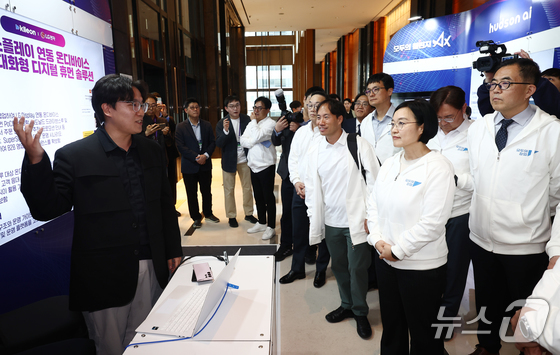
Genome & Company closed up approximately 25% at KRW 6,080, its sharpest single-session gain in recent memory. The catalyst was an investor briefing held at Conrad Seoul in Yeouido, where management laid out an aggressive licensing roadmap: at minimum one deal each in 2025 and 2026, anchored by two novel-target ADC assets.
The company, originally built on microbiome-based drug discovery, formally pivoted its R&D strategy in 2023 toward proprietary-target ADCs a shift management described as a response to the increasingly winner-take-all dynamics of the global oncology market. The two lead assets are GENA-104, targeting the novel immune checkpoint CNTN4 (Contactin-4), and GENA-120, directed against integrin β4 (ITGB4).
GENA-104, which received its first full preclinical profile disclosure at the American Association for Cancer Research (AACR) annual meeting this year, is distinguished by a dual mechanism of action: in addition to conventional payload-mediated cytotoxicity, the compound restores T-cell-mediated tumor killing suppressed by CNTN4 overexpression on cancer cells.
In patient-derived xenograft (PDX) models, GENA-104 achieved a tumor growth inhibition (TGI) rate exceeding 100% in tumors with H-scores above 150. High CNTN4 expression was confirmed across melanoma including acral and mucosal subtypes with historically poor immunotherapy response rates as well as hepatocellular carcinoma, non-small cell lung cancer and sarcoma.
GENA-120, disclosed publicly for the first time at Monday's briefing, targets ITGB4, an antigen with confirmed tumor-specific overexpression across colorectal, head and neck, esophageal, gastric, cervical and lung cancers. In vitro data demonstrated potent ITGB4 expression-dependent cytotoxicity and induction of immunogenic cell death. The company's closest known competitor in this space is China's SystImmune, which presented a poster on the same target at AACR 2025 and has flagged a China IND filing in Q4 2025.
"The commercial landscape for validated-target ADCs is already locked up by first movers," said CEO Hong Yu-seok. "Our thesis is that first-in-class entry even with an average efficacy profile retains commercial viability, whereas best-in-class latecomers in crowded targets struggle to gain traction. Current market capitalization does not adequately reflect the potential of our novel ADC assets."
A sell-side analyst covering Korean biotech noted: "Genome & Company's proactive positioning in underpenetrated target classes is a meaningful differentiator. In an environment where global biopharma is aggressively scouting ADC pipeline additions, the probability of a meaningful preclinical licensing deal has materially increased. A confirmed out-licensing transaction would serve as a significant re-rating catalyst."
The company also highlighted its dual-antibody ADC GNB-120, which co-targets ITGB4 and HER2 using a 1+1 avidity structure designed to restrict binding to cells co-expressing both antigens — a strategy aimed at tackling HER2-positive indications currently inaccessible to approved HER2 ADCs. In pancreatic cancer cell lines, GNB-120 demonstrated up to a 7-fold improvement in anti-tumor efficacy versus existing HER2 ADCs. Lead candidate selection is targeted for late 2025 or early 2026.
LabGenomics
◇LabGenomics, Institutional Capital Inflow Sparks Rally
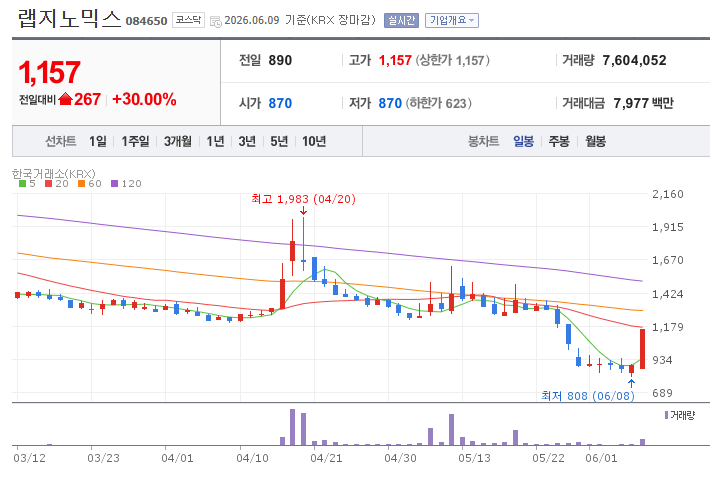
LabGenomics (KOSDAQ: 084650) surged approximately 27% to close at KRW 1,130, posting the session's steepest gain among the three names. The move followed disclosure that STICK Investment one of South Korea's leading private equity managers had subscribed to KRW 20 billion (approximately USD 14.6 million) in the company's fifth unsecured private convertible bonds (CBs) through its vehicle Stick Litmus Co., Ltd.
The CBs, issued at a conversion price of KRW 1,466 per share, are convertible into approximately 13.64 million common shares, representing a potential stake of roughly 18.38% a substantial strategic foothold for a financial investor. The proceeds are earmarked for acquisition of securities in third-party entities, widely interpreted by the market as funding for further M&A to expand LabGenomics' global diagnostic platform.
Founded on proprietary expertise in PCR, multiplex molecular diagnostics (MDx), next-generation sequencing (NGS) and non-invasive prenatal testing (NIPT) having commercialized Korea's first NGS-based NIPT LabGenomics has been executing an international expansion strategy anchored by its 2024 acquisition of a U.S.-based CLIA-certified laboratory. The move gave the company direct access to the world's largest in-vitro diagnostics market.
"The entry of a rigorous institutional investor of STICK's caliber provides a credible floor on LabGenomics' valuation," said one fixed-income analyst at a Seoul-based brokerage. "With the domestic IVD sector in structural consolidation post-COVID, the critical variable for the medium-term investment thesis is whether the company can translate its U.S. laboratory footprint into recurring revenue."
KohYoung
◇Koh Young Technology, SOCAMM2 Win Opens AI Memory Beachhead
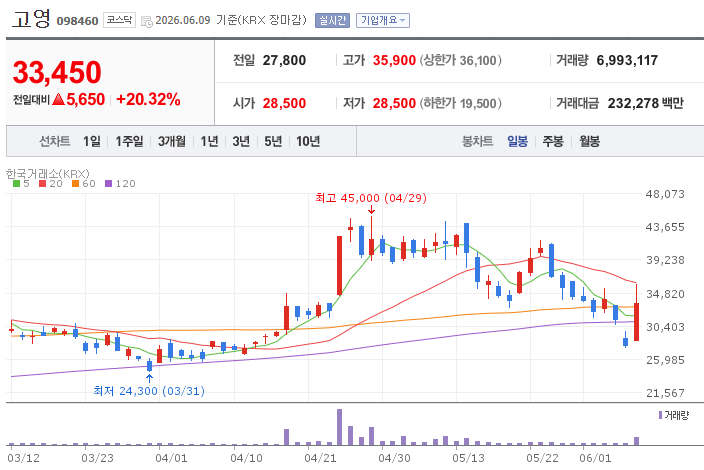
Koh Young Technology (KOSDAQ: 098460) closed up approximately 21% at KRW 33,600 after the company announced it had secured its first purchase order for inspection equipment related to SOCAMM2 (Small Outline Compression Attached Memory Module 2) from a major domestic memory manufacturer.
The announcement marks Koh Young's entry into the next-generation AI memory inspection segment. SOCAMM2 is a compact, high-bandwidth, power-efficient memory module designed for co-location with CPUs and AI accelerators in data center servers increasingly cited alongside HBM as a foundational component of AI infrastructure build-outs.
Koh Young holds the global No. 1 position in 3D automated optical inspection (AOI) equipment for surface-mount technology (SMT) processes. The company has been diversifying beyond its core business into semiconductor advanced packaging inspection and neurosurgical robotic assistance the latter with over 800 procedures completed domestically.
Underlying operational momentum further supports the re-rating narrative. First-quarter 2026 revenue came in at KRW 72.7 billion, up 42% year-on-year, while operating profit surged 209% to KRW 9.9 billion and net income jumped 389% to KRW 15.7 billion.
"This is not a marginal product extension it positions Koh Young as a critical equipment vendor within the global AI server supply chain," said a semiconductor sector analyst at a domestic securities firm. "Structural growth in next-generation memory inspection demand, driven by accelerating AI infrastructure investment, should provide durable earnings uplift well beyond the current cycle."
A company spokesperson added: "Demand for inspection equipment related to optical modules in addition to SOCAMM is also rising. We intend to actively expand our supply capacity across these product lines."