The pharmaceutical sector index fell 2.33% from the previous trading session. Of the 160 stocks in the sector, 41 advanced, 13 remained unchanged and 106 declined.
The life sciences sector dropped 5.97%, marking the steepest decline among all industry groups. Of the sector’s 91 stocks, 24 gained, 10 were unchanged and 57 fell, reflecting weakness similar to that seen across the pharmaceutical sector.
Meanwhile, stocks linked to medical abortion drugs gained ground after President Lee Jae-myung called for institutional reforms to allow the appropriate use of Mifegyne, an abortion medication.
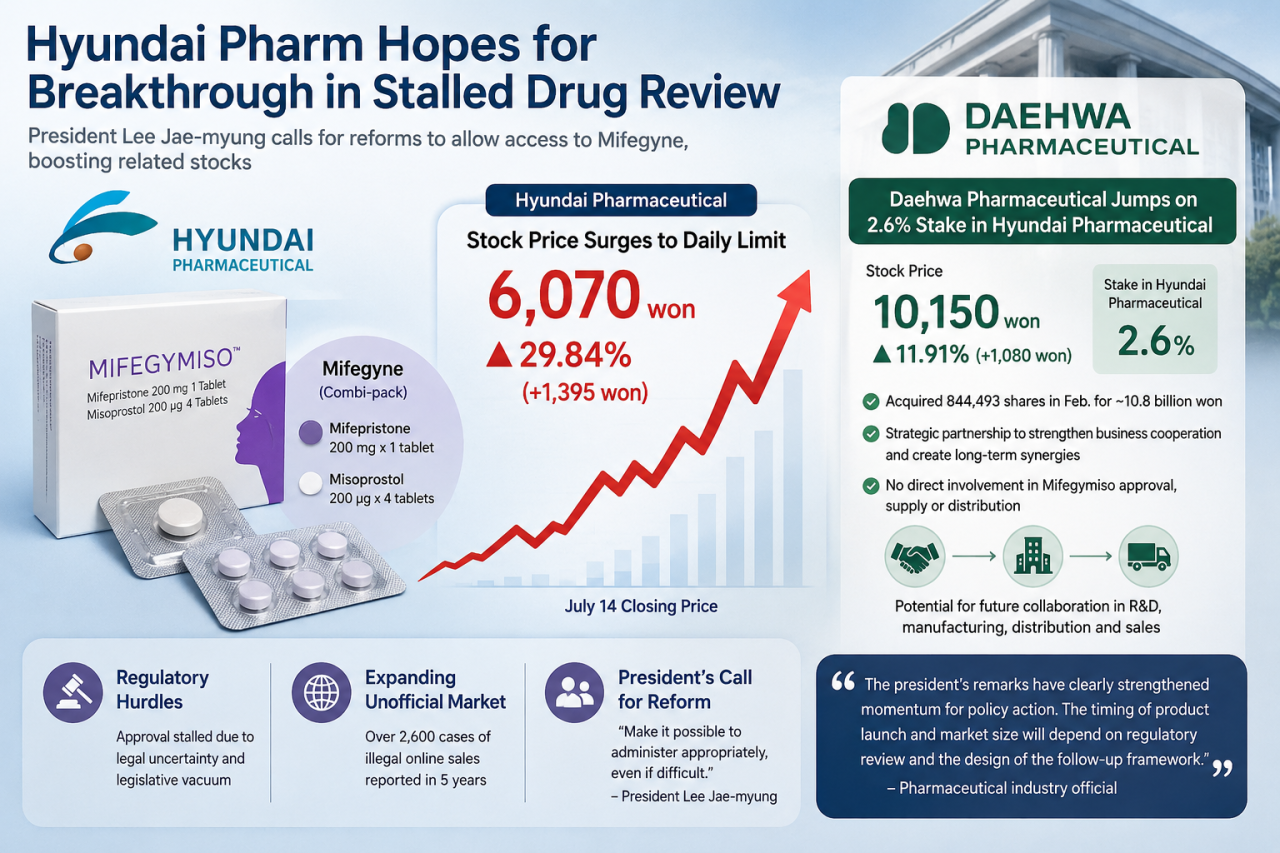
◇Hyundai Pharm Hopes for Breakthrough in Stalled Drug Review
Hyundai Pharmaceutical surged to the daily price limit after President Lee Jae-myung said the government should improve the regulatory framework to enable access to Mifegyne.
According to KG Zeroin’s MP Doctor, Hyundai Pharmaceutical rose 29.84%, or 1,395 won, from the previous session to 6,070 won, reaching the maximum daily gain allowed on the domestic stock market.
During a Cabinet meeting, Lee said the government should make it possible for the medication to be administered appropriately, even if doing so presents administrative difficulties.
His remarks were widely interpreted as a call to bring abortion medications, which are not formally approved in South Korea but are distributed through unofficial channels such as overseas direct purchases, into the regulated medical system.
Mifegyne-based medical abortion generally involves two active ingredients: mifepristone and misoprostol.
In 2021, Hyundai Pharmaceutical signed an agreement with UK-based Linepharma International for the exclusive domestic rights and supply of Mifegymiso, a combi-pack containing both mifepristone and misoprostol.
Mifegymiso consists of one 200 mg tablet of mifepristone and four 200 μg tablets of misoprostol.
Mifepristone blocks the action of progesterone, a hormone required to maintain pregnancy, while misoprostol induces uterine contractions to facilitate the expulsion of pregnancy tissue.
The World Health Organization includes both mifepristone and misoprostol on its Model List of Essential Medicines and recognizes medication abortion using the two substances as a safe and effective method.
Hyundai Pharmaceutical resubmitted its application for marketing approval of Mifegymiso to the Ministry of Food and Drug Safety at the end of 2024. However, the review and introduction of the product have been delayed amid a legislative vacuum concerning the permissible scope of abortion and standards governing the use of abortion medications.
The company submitted data from three clinical trials conducted in the United States and Mexico as supporting evidence for the application. The reported abortion success rates were 94.9%, 96.2% and 97.3%, respectively.
Hyundai Pharmaceutical maintains that administering 200 mg of mifepristone followed by 800 μg of misoprostol is effective in terminating pregnancies of up to 63 days.
However, the domestic approval process has remained stalled for years because of legal uncertainty.
The Ministry of Food and Drug Safety has maintained that legislation must first establish whether medication abortion is permitted and up to what stage of pregnancy it may be used before the regulator can determine essential approval conditions, including indications, dosage, administration and risk-management requirements.
As a result, Mifegymiso formally remains under regulatory review, but substantive progress in the assessment has reportedly been limited.
In 2019, South Korea’s Constitutional Court ruled that the country’s criminal abortion provisions were unconstitutional and ordered their revision. The relevant provisions lost effect in 2021.
However, follow-up legislation defining the permissible timing and methods of abortion, standards for medication use and the responsibilities of medical professionals has yet to be completed.
In the meantime, the unofficial online market has expanded. More than 2,600 cases involving the illegal online sale or brokerage of abortion medications have reportedly been detected over the past five years.
Safety concerns have persisted because drugs whose authenticity and dosage cannot be verified are being distributed without medical diagnosis or professional instructions on their use.
“The president’s direct remarks on the need to introduce Mifegyne have clearly strengthened the momentum for policy action,” a pharmaceutical industry official said. “However, the timing of an actual product launch and the potential size of the market will depend on the regulatory review and the design of the follow-up institutional framework.”
◇Daehwa Pharmaceutical Jumps on 2.6% Stake in Hyundai Pharmaceutical
Daehwa Pharmaceutical posted a double-digit gain following President Lee’s remarks on Mifegyne.
Investors appeared to focus on the company’s stake in Hyundai Pharmaceutical, which is regarded as a potential beneficiary of the introduction of medication abortion products in South Korea.
According to MP Doctor, Daehwa Pharmaceutical closed at 10,150 won, up 1,080 won, or 11.91%, from the previous session.
As shares of Hyundai Pharmaceutical soared, investor interest spread to Daehwa Pharmaceutical, which has established a strategic partnership with the company.
Daehwa Pharmaceutical’s corporate logo. (Image courtesy of Daehwa Pharmaceutical)
In February, Daehwa Pharmaceutical acquired 844,493 shares of Hyundai Pharmaceutical for approximately 10.8 billion won. The acquisition gave Daehwa Pharmaceutical a 2.6% stake in the company.
At the time, Daehwa Pharmaceutical said the investment was intended to strengthen business cooperation, establish a strategic partnership and create medium- to long-term business synergies.
“Daehwa Pharmaceutical is not directly involved in the Mifegyne-related business, but investors appear to have focused on its position as a major shareholder and strategic partner of Hyundai Pharmaceutical,” an industry official said.
“Expectations that cooperation between the two companies could eventually expand into joint research and development, manufacturing, distribution and sales also appear to have supported the share price.”
However, Daehwa Pharmaceutical has not officially announced any direct involvement in the domestic approval, supply or distribution of Mifegymiso.
◇Bio Solution, IND Approval for Injectable Osteoarthritis Therapy
Bio Solution closed higher after receiving approval for a domestic clinical trial of Spherocure, its injectable treatment candidate for knee osteoarthritis.
According to MP Doctor, Bio Solution finished at 5,930 won, up 320 won, or 5.70%, from the previous session.
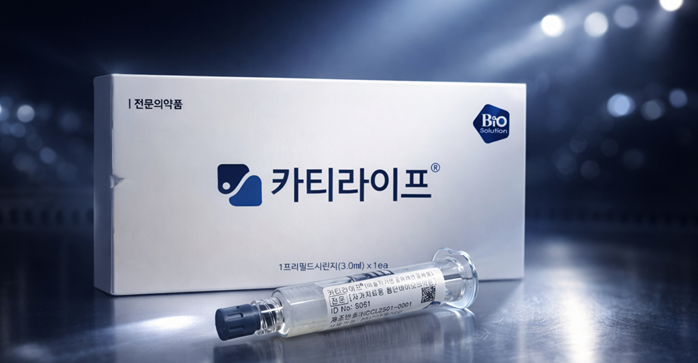
Investor sentiment was buoyed by the clinical advancement of a cell therapy designed to be administered through a single intra-articular injection without the need for knee surgery.
Bio Solution received approval from the Ministry of Food and Drug Safety to conduct a domestic Phase 1/2a clinical trial of Spherocure. The authorization came approximately eight months after the company submitted its investigational new drug application in November last year.
Spherocure is an allogeneic cell therapy combining three-dimensional cell spheroid culture technology with a cartilage differentiation stimulation platform.
The treatment is designed to continuously secrete therapeutic substances within the joint, reducing pain while improving the structure of damaged cartilage. The company aims to develop it as a disease-modifying osteoarthritis drug, or DMOAD.
The trial will enroll patients with Kellgren-Lawrence grade 2 or 3 knee osteoarthritis.
In Phase 1, up to 18 patients will be enrolled to evaluate the safety and tolerability of different dose levels and determine an appropriate dose.
The subsequent Phase 2a portion will enroll 41 patients, or as many as 68, in a multicenter, randomized, double-blind and placebo-controlled study to evaluate efficacy.
At 24 weeks after treatment, researchers will assess pain using a visual analogue scale and joint function using the Western Ontario and McMaster Universities Osteoarthritis Index.
Magnetic resonance imaging and biomarkers will also be used to explore whether the treatment can improve cartilage structure.
Spherocure was developed with support from the government-funded Regenerative Medicine Acceleration Foundation program, jointly promoted by the Ministry of Science and ICT and the Ministry of Health and Welfare.
Bio Solution has also secured a domestic patent and filed an international application under the Patent Cooperation Treaty.
“Spherocure is a next-generation core drug candidate that integrates our commercialization experience with CartiLife and the clinical development expertise accumulated through CartiRoid,” Bio Solution CEO Lee Jung-sun said.
“Based on the domestic clinical trial, we will accelerate our efforts to enter overseas clinical development and establish global business-development partnerships.”