Graphy said Tuesday that Tera Harz E-Namel received domestic manufacturing certification on Sept. 7 as a Class II medical device classified as a crown resin (C07070.01). The company has also submitted a 510(k) premarket notification to the U.S. Food and Drug Administration as it seeks to enter the U.S. market.
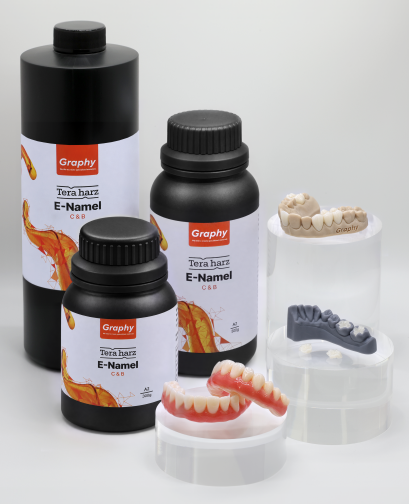
Graphy's 3D-printing esthetic dental prosthetic material, Tera Harz E-Namel (R-191). (Photo=Graphy)
Tera Harz E-Namel is a light-curable 3D-printing prosthetic material made from a polymer containing 53% inorganic ceramic filler. It is designed to allow dental prosthetics, including crowns, bridges, inlays and onlays, to be digitally designed and printed directly with a 3D printer.
Graphy plans to expand the material's applications to implant crowns and full-arch restorations, including All-on-X prostheses.
Crown resin is a medical device material used to make permanent dental restorations, including crowns and bridges. The manufacturing certification allows Graphy to manufacture and sell Tera Harz E-Namel in South Korea as a crown resin.
Conventional zirconia restorations are made by milling blocks or discs of material and then sintering them. Tera Harz E-Namel instead allows restorations to be printed directly from digital design data before undergoing post-processing.
Graphy plans to provide not only the material but also 3D printers, post-processing equipment, process training and technical support for printing and quality control.
The company's move into prosthetic materials is aimed at expanding the applications of the 3D-printing material technology it has developed for its core clear aligner business.
Graphy has commercialized and sells its Shape Memory Aligner, or SMA, a shape-memory clear aligner made by directly 3D-printing light-curable materials. The new product expands its portfolio beyond orthodontic appliances into materials used to manufacture dental prosthetics.
Graphy is also pursuing cooperation with MegaGen Implant in the implant sector. The company plans to develop a business model linking implant treatment with prosthetic fabrication using Tera Harz E-Namel, combining material supply with support for printing and post-processing. Graphy has previously pursued business cooperation with MegaGen Implant, including product supply and distribution.
Graphy is also proceeding with the U.S. regulatory process. The company has submitted an FDA 510(k) premarket notification for Tera Harz E-Namel and aims to obtain clearance in the fourth quarter of this year.
The FDA's 510(k) process requires medical device manufacturers to demonstrate that a device is substantially equivalent to a legally marketed predicate device before it can be marketed in the United States.
"Tera Harz E-Namel expands Graphy's accumulated light-curable 3D-printing materials technology from orthodontics into esthetic prosthetics," Graphy CEO Shim Woon-seop said. "We will expand its applications from crowns and bridges to implant crowns and grow our prosthetic materials business by combining the material with equipment, process training and technical support."