South Korea’s pharmaceutical and biotech sector saw notable moves on Sept. 21, led by SkyLabs, which hit the upper price limit after nine consecutive trading sessions of declines. The digital healthcare company, which develops a ring-shaped blood pressure monitor, drew attention from U.S. media as it pursues approval from the U.S. Food and Drug Administration (FDA).
HLB Pharmaceutical also posted a sharp gain ahead of the FDA’s decision on a new bile duct cancer drug being developed by HLB Group. Meanwhile, Orum Therapeutics continued to fall following the termination of its drug development collaboration with Bristol Myers Squibb (BMS).
◇SkyLabs Hits Upper Limit After Nine-Day Slide; Named Top HealthTech Company by TIME
According to KG Zeroin MP Doctor, SkyLabs closed at 25,250 won on Sept. 21, up 29.89%, or 5,810 won, from the previous session, hitting the upper price limit. The stock surged from the opening, breaking above the 22,000-won level, and reached the upper limit at around 10:50 a.m.
SkyLabs, which listed on the KOSDAQ on Sept. 4, closed at 23,500 won on its first trading day, up 135% from its IPO price. The following day, the stock hit the upper price limit and closed at 30,550 won. However, it subsequently declined for nine consecutive trading sessions from Sept. 8 through Sept. 18 before rebounding with another upper-limit gain on Sept. 21.

SkyLabs recent stock trend.(KG Zeroin MP DOCTOR)
The rally was attributed to expectations for SkyLabs’ expansion into the U.S. market. The company has already supplied its devices to more than 2,000 hospitals and clinics across South Korea and is rapidly increasing overseas sales. Of approximately 5 billion won in revenue generated in the first half of this year, overseas sales accounted for 2.6 billion won, or 52%.
SkyLabs said it has completed consultations with the FDA on the design of clinical trials and is targeting U.S. market entry through regulatory approval by the end of 2027.
The company also announced that it had been selected for TIME magazine’s “World’s Top HealthTech Companies of 2026.” SkyLabs was the only South Korean company selected in the medical devices and wearables category.
SkyLabs commercialized the Cart BP Pro, a cuffless ring-type blood pressure monitor that continuously tracks blood pressure for 24 hours without disrupting sleep or daily activities.
Conventional blood pressure monitoring has largely relied on measurements taken at specific points in time. The company’s ring-shaped monitor is designed to continuously track changes in blood pressure during daily activities and sleep. The technology has attracted attention for its potential to monitor vital signs while reducing the burden on elderly users.
“We are honored that our wearable medical device technology developed in Korea has been recognized for its competitiveness in the global market,” SkyLabs CEO Lee Byung-hwan said. “We will expand into the global medical device and healthcare data markets by continuously generating and utilizing clinically reliable blood pressure and other biometric data.”
◇HLB Bile Duct Cancer Drug Nears FDA Decision
HLB Pharmaceutical also posted a sharp gain. According to KG Zeroin MP Doctor, the company’s shares closed at 7,650 won, up 23.19%, or 1,440 won, from the previous session.
The stock’s rally was attributed to expectations for FDA approval of a bile duct cancer drug being developed by Elevar Therapeutics, HLB’s U.S. subsidiary.
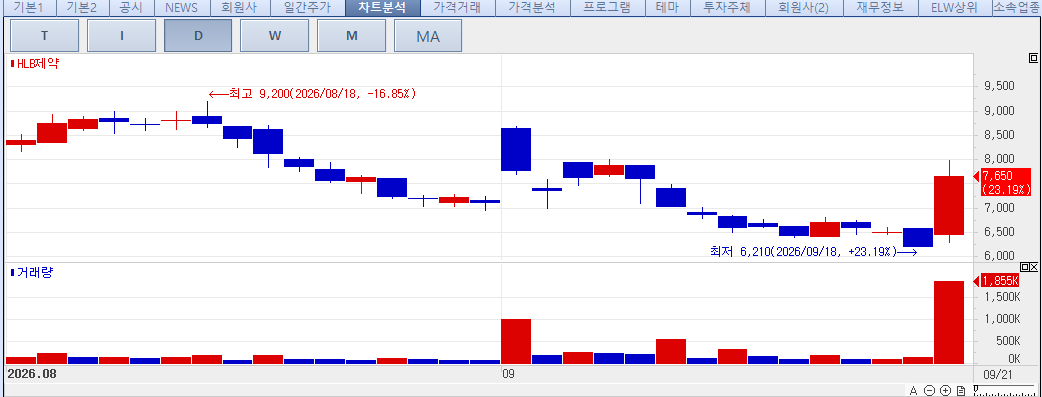
HLB Pharmaceutical recent stock trend.(KG Zeroin MP DOCTOR)
HLB said its FGFR2-targeted anticancer drug lirafugratinib, marketed in the U.S. under the name LYRFIGTU, had received a conditional acceptance from the FDA. Lirafugratinib is currently under Priority Review as a second-line treatment for patients with advanced or metastatic cholangiocarcinoma (CCA) harboring FGFR2 fusions or rearrangements. The FDA’s target action date is Sept. 25.
Lirafugratinib is an irreversible inhibitor designed to selectively target FGFR2 within the FGFR family. According to the company, the drug was designed to reduce adverse effects associated with off-target inhibition, a limitation of existing FGFR inhibitors. Its selective binding to FGFR2 is also intended to provide sustained inhibitory activity.
Elevar entered into an agreement with U.S.-based Relay Therapeutics in December 2024 to acquire the rights to the drug candidate, marking the start of its development of the bile duct cancer treatment. The drug was designated a Breakthrough Therapy by the FDA in 2023 and received Priority Review status in March this year.
HLB Pharmaceutical manufactures and sells pharmaceutical products within the HLB Group and operates a contract manufacturing organization (CMO) business.
Although the company has no direct connection to the FDA approval of lirafugratinib, industry observers have raised the possibility that HLB Pharmaceutical could benefit as the group’s manufacturing arm if the drug is approved.
An HLB official, however, said there had been no confirmed plans regarding production of the drug.
◇BMS Returns Rights; Orum Therapeutics Loses Half Its Value in Three Sessions
Orum Therapeutics continued to feel the impact of BMS’ decision to discontinue development of the blood cancer candidate ORM-6151 and return the rights to the company.
Orum Therapeutics’ shares fell 29.28%, or 10,950 won, to close at 26,450 won, posting a decline close to the daily lower price limit. The stock had been trading in the 50,000-won range before BMS announced the return of the rights on Sept. 16, meaning its share price has effectively been cut in half in just three trading sessions.
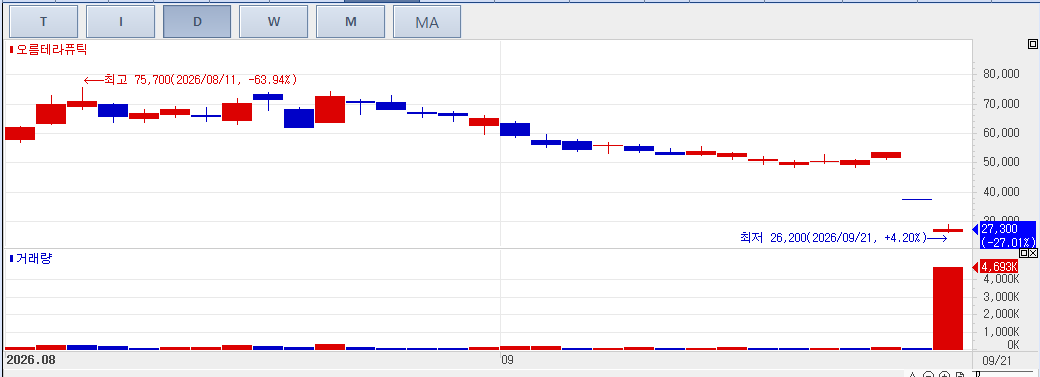
Orum Therapeutics recent stock trend.(KG Zeroin MP DOCTOR)
BMS had licensed ORM-6151 from Orum Therapeutics in 2023. The deal had a total potential value of $180 million, or approximately 248.4 billion won at the time. Orum received $100 million in upfront payments, which were non-refundable. Following the termination of development, Orum will lose the opportunity to receive up to $80 million in development milestones.
ORM-6151, whose development was discontinued, is based on Orum Therapeutics’ antibody-drug conjugate degrader (DAC) technology and had effectively served as a flagship candidate for the company’s DAC platform.
DAC combines elements of antibody-drug conjugates (ADCs) and targeted protein degraders (TPDs). The technology remains an emerging approach, with no company having yet commercialized a DAC therapy globally.
While ADCs attach highly potent cytotoxic payloads to antibodies, DACs link a TPD that acts as a catalytic agent to an antibody, with the goal of achieving therapeutic effects with smaller quantities while reducing adverse effects.
The continued decline in Orum Therapeutics’ share price has also been attributed to concerns over its broader DAC platform, as its next-generation candidates are also based on the technology. With the development of a candidate that had helped raise the company’s valuation through its licensing deal with BMS now discontinued, investor confidence in the company’s DAC platform has also come under pressure.
Orum Therapeutics said it plans to proceed with clinical development of its follow-up pipeline candidate ORM-1153 as scheduled.ㅇ