
An exterior view of Vaxcell-Bio’s facilities. (Photo=Vaxcell-Bio)
Vaxcell-Bio, Shaperon and HLB Group companies were among the session’s standouts. Vaxcell-Bio drew attention as the government moved to ease regulations on treatments that use patients’ own immune cells. In a liver cancer trial, 11 of 16 evaluable patients responded to a combination regimen that included the company’s natural killer (NK) cell therapy.
Shaperon said the U.S. Patent and Trademark Office had allowed its patent application for a CD47-targeting nanobody. In laboratory testing, the nanobody showed no binding to human red blood cells even at a concentration 1,000 times that of the conventional antibody used for comparison. HLB Group stocks rallied ahead of the planned U.S. launch of Lirafugratinib, its FDA-approved bile duct cancer drug marketed under the brand name Lifyorli.
◇Vaxcell-Bio rises on prospects for regulatory relief
Vaxcell-Bio closed at 4,025 won, up 300 won, or 8.05%, from the previous session, according to KG Zeroin’s MP Doctor. Investors focused on what the government’s proposed changes to advanced regenerative medicine rules could mean for VCB-1102, the company’s investigational NK cell therapy for liver cancer.
On Oct. 30, Pharm Edaily published a subscriber-only article titled “Vaxcell-Bio sees responses in 11 of 16 liver cancer patients, sets sights on Korea’s second advanced regenerative medicine treatment approval.”
The government proposes to lower the risk classification of treatments that use a patient’s own cultured immune cells from medium to low. Under the proposed change, medical institutions could use published clinical evidence to apply for a review of their treatment plans without first conducting a separate advanced regenerative medicine study, a process that typically takes two to three years. The Ministry of Health and Welfare reaffirmed the proposal in a regulatory reform package announced on Oct. 23.
VCB-1102 uses cancer-fighting NK cells collected from a liver cancer patient’s blood. The cells are expanded in the laboratory and then infused back into the patient. In April, Yeouido St. Mary’s Hospital received Korea’s first treatment-plan approval under the framework for the use of VigenCell’s autologous immune cell therapy VT-EBV-N in a rare form of lymphoma. Vaxcell-Bio is seeking the country’s second such approval, this time for liver cancer.
A Phase 2a study published on Oct. 16 in Cancer Research and Treatment provides clinical evidence for the proposed treatment. Patients with locally advanced hepatocellular carcinoma first received two cycles of hepatic arterial infusion chemotherapy (HAIC), which delivers chemotherapy directly into the artery supplying the liver. Patients whose cancer had not progressed then received VCB-1102 alongside further HAIC.
Of the 17 patients enrolled, 16 were evaluable for response. Three had a complete response, meaning imaging showed no remaining viable tumor, and eight had a partial response, meaning the viable tumor had shrunk enough to meet the study’s response criteria. The objective response rate was 68.75%. Investigators reported a median time to progression of 16.82 months.
“Publication of this paper has allowed us to share the results of the VCB-1102 Phase 2a trial with the international scientific community,” a Vaxcell-Bio representative said. “We will continue the clinical development of VCB-1102 and work toward approval for its use as a treatment under the Advanced Regenerative Medicine Act.”
◇Shaperon gains 8.56% on U.S. patent decision
Shaperon closed at 2,410 won, up 190 won, or 8.56%, following the U.S. patent decision and the company’s report of preclinical findings for its cancer immunotherapy program. In addition to reporting no binding to human red blood cells in laboratory testing, Shaperon said it observed no hemolysis, or red blood cell destruction, in a study in monkeys.
The U.S. patent application covers the CD47 nanobody and its uses. The decision follows patent allowances in South Korea, Australia and Japan, broadening the intellectual property portfolio Shaperon can bring to licensing talks with global drugmakers.
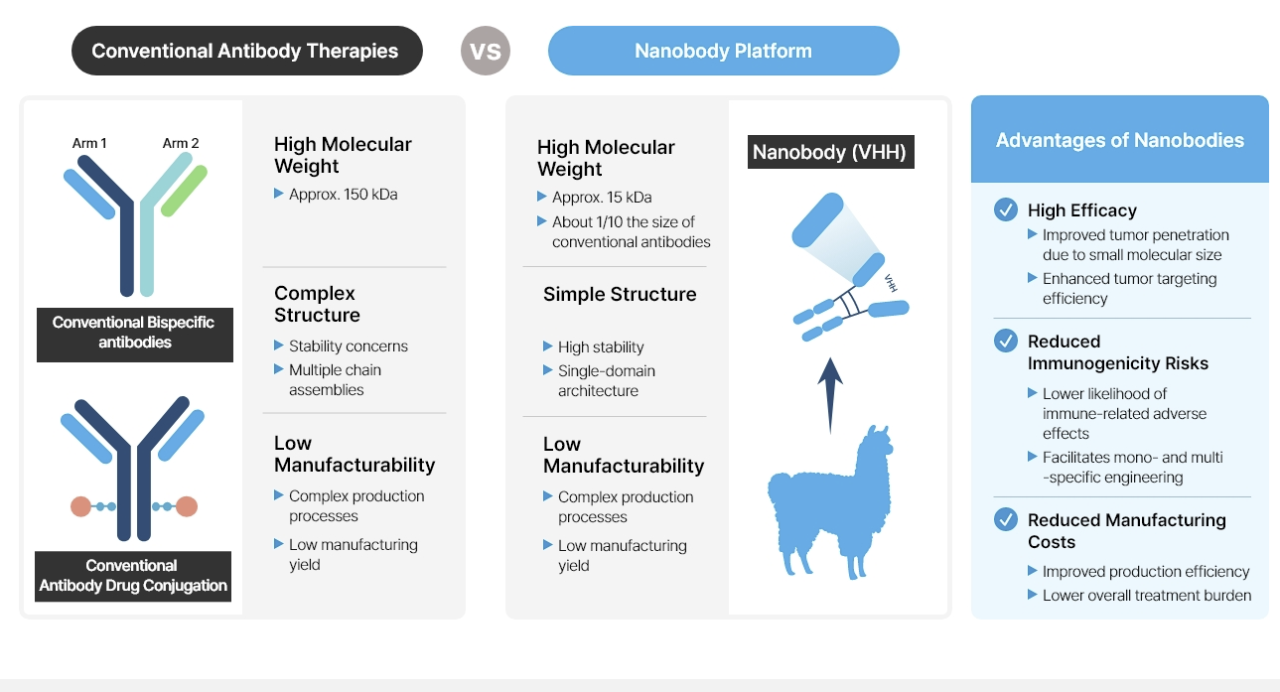
Nanobodies have about one-tenth the molecular weight of conventional antibodies (15 kDa vs. 150 kDa), which may help them penetrate tumors more deeply. (Source=Shaperon)
CD47 is a protein that cancer cells use to evade the immune system. On the surface of a cancer cell, it sends a “don’t eat me” signal to macrophages, immune cells capable of engulfing the tumor cell. Blocking the signal can allow macrophages to attack. The challenge is that healthy red blood cells also carry CD47. If an antibody binds to CD47 on those cells, the immune system can clear them from circulation, potentially causing anemia.
Shaperon designed its nanobody, about one-tenth the size of a conventional antibody, to avoid binding to red blood cells. Its drug candidate targets both CD47 and PD-L1, a protein that suppresses T-cell activity. The aim is to enable T cells to attack cancer cells directly while allowing macrophages to engulf them. Shaperon is developing the treatment for patients who respond inadequately to existing PD-L1 immunotherapies or develop resistance to them.
“We plan to accelerate licensing discussions with global pharmaceutical companies, backed by the safety data from our animal studies and our international patent portfolio, including in the United States,” a Shaperon representative said.
◇HLB Group rally ahead of U.S. bile duct cancer drug launch
HLB Biostep rose by the daily trading limit as HLB Group stocks rallied ahead of the U.S. launch of the group’s bile duct cancer drug. According to MP Doctor, HLB Biostep closed at 6,870 won, up 29.87% from the previous session.
HLB Pharmaceutical gained 1,210 won, or 12.74%, to close at 10,710 won. HLB Therapeutics rose 235 won, or 9.42%, to 2,730 won. HLB Pep gained 270 won, or 7.09%, to 4,080 won, while HLB Panagene rose 79 won, or 6.27%, to 1,338 won.
Elevar Therapeutics, HLB Group’s U.S. subsidiary, received U.S. Food and Drug Administration approval for the drug in September for patients with locally advanced or metastatic cholangiocarcinoma harboring an FGFR2 fusion or rearrangement. At the 2026 European Society for Medical Oncology Congress in Madrid, Elevar operated its own booth and met with clinicians and pharmaceutical distributors to discuss the U.S. launch.
진양곤 HLB 의장, 계열사 주식 8만주 추가 매
Pricing and distribution will be central to the rollout. Competing drugs cost about $30,000, or roughly 40 million won, per month in the United States. The group expects the drug’s clinical results to support a price 15% to 20% above competing therapies. Elevar plans to handle U.S. sales directly. In Europe, the European Medicines Agency is reviewing the company’s marketing authorization application.
In liver cancer, the group is again seeking FDA approval for rivoceranib in combination with camrelizumab as a first-line treatment. The application is back under FDA review after the company addressed manufacturing facility issues. Separately, HLB Therapeutics expects to report top-line results next month from a U.S. Phase 3 trial of RGN-259, its investigational treatment for neurotrophic keratitis.
HLB Group Chairman Jin Yang-gon has made 15 open-market purchases of shares in affiliates including HLB Therapeutics, HLB Innovation and HLB Genex. He bought the shares both personally and through Epoche, an investment firm in which he owns a 99% stake.
“We are preparing for the successful U.S. launch of our bile duct cancer drug while working to demonstrate the clinical performance of rivoceranib and the other candidates in our pipeline,” an HLB Group representative said. “Management’s share purchases also reflect confidence in the group’s future growth.”