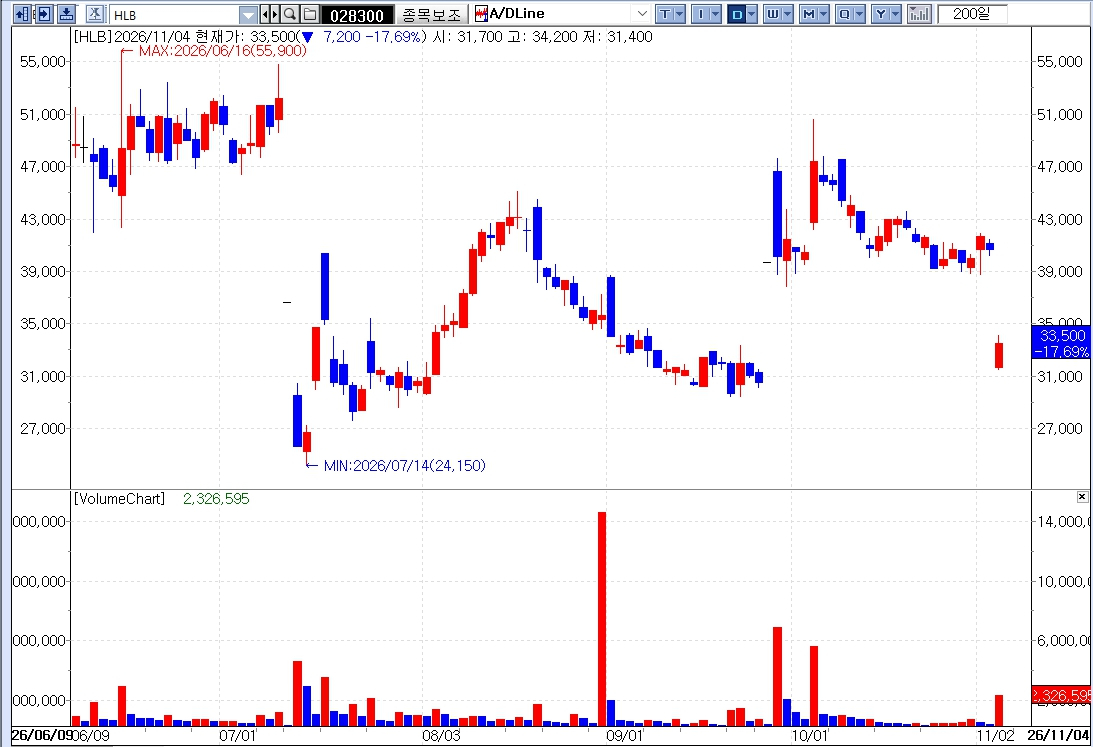
HLB's recent stock performance. Shares fell 17.69% to close at 33,500 won on Nov. 4 after the U.S. Food and Drug Administration classified the resubmitted application for its rivoceranib-camrelizumab combination therapy as Class 2. (Source=KG Zero-in MP doctor)
◇HLB Sinks as FDA Extends Review Timeline
HLB shares plunged 17.69% to 33,500 won ($23), while affiliate HLB BioStep dropped 22.68% to 5,080 won, the steepest decline among major group companies. HLB Life Science and HLB Pharmaceutical also posted double-digit losses.
The selloff followed the U.S. Food and Drug Administration's decision to classify the resubmitted application for HLB's liver cancer combination therapy, rivoceranib and camrelizumab, as a Class 2 resubmission.
Under FDA rules, Class 1 resubmissions generally receive a two-month review, while Class 2 applications face a six-month timeline. The agency set April 9, 2027, as its target decision date.
Investors had anticipated a faster review after HLB Chairman Jin Yang-gon suggested in October that approval could come before year-end.
An HLB official said the company had expected Class 1 treatment because inspections of manufacturing facilities for both the active pharmaceutical ingredient and finished product had concluded with voluntary action indicated classifications.
"We believed the major regulatory obstacles had been resolved," the official said. "We thought Class 1 was possible, but the market appears to have interpreted that expectation too definitively."
The official added that the FDA had not disclosed specific reasons for the Class 2 classification or indicated whether additional inspections would be required.
HLB BioStep's particularly sharp decline may also reflect profit-taking after a rally that included three consecutive daily-limit gains in October and another nearly 30% jump on Nov. 2.
◇Hugel Slides on 62% Profit Drop
Hugel shares fell as much as 12.36%, from 191,000 won to 167,400 won, following disappointing third-quarter results. The stock recovered some losses after the company announced a treasury share cancellation worth approximately 53.7 billion won, closing 2.90% lower at 184,000 won.
Third-quarter revenue fell 7.9% year over year to 97.5 billion won, while operating profit plunged 61.8% to 18.1 billion won.
The downturn stemmed largely from restructuring Hugel's U.S. distribution network for its botulinum toxin product, Letybo.
Hugel is transitioning its U.S. distribution partner, BENEV, into a contract sales organization ahead of a planned shift to full direct sales in the second half of 2027.
As part of that transition, Hugel repurchased product previously supplied to BENEV, recognizing the one-time financial impact entirely in the third quarter.
"We repurchased products that had already been supplied to our distribution partner," a Hugel official said. "Rather than spreading the financial impact across multiple quarters, we decided to recognize it all in the third quarter."
The company expects U.S. revenue to normalize in the fourth quarter, citing continued growth in cumulative sales volumes and revenue in the local market.
Letybo received FDA approval in February 2024 and entered the U.S. market in 2025. Competing against established brands including Botox, Dysport and Jeuveau, Hugel is emphasizing its Korean market leadership and clinical evidence suggesting limited toxin diffusion beyond the injection site.
Outside the United States, domestic sales of toxins, fillers and skin boosters rose 54% year over year to 27.4 billion won. Sales in Europe and other regions increased 18%, while Brazil recorded its highest quarterly revenue.
◇AriBio Hits Daily Limit Ahead of Alzheimer's Trial Results
AriBio Holdings jumped 29.98% to 3,620 won, reaching the daily price ceiling shortly before the close as investors anticipated Phase 3 results for its experimental Alzheimer's treatment, AR1001.
AriBio plans to present topline data from its global Phase 3 POLARIS-AD trial on Nov. 16 at the Clinical Trials on Alzheimer's Disease conference in Boston.
The 52-week study enrolled 1,535 patients with early Alzheimer's disease across 13 countries, evaluating the efficacy and safety of once-daily oral AR1001.
The results could also trigger substantial additional payments under AriBio's licensing agreement with China's Fosun Pharma.
In May, AriBio signed an option and licensing agreement with Fosun worth up to $4.7 billion. The company had received $60 million in upfront option payments by July and could collect another $80 million linked to the Phase 3 readout, subject to contractual conditions.
"Depending on the topline results, we could receive an additional option payment from Fosun, effectively serving as a second upfront payment," an AriBio Holdings official said. "Further milestone payments could also follow."
AR1001 inhibits phosphodiesterase-5, or PDE5, and is being developed to target multiple pathways associated with Alzheimer's disease, including cerebral blood flow and neuronal protection.
Unlike approved antibody treatments Leqembi and Kisunla, which target amyloid-beta and require injections or infusions, AR1001 is designed as a once-daily oral therapy. Its clinical effectiveness remains to be established by the upcoming Phase 3 results.